

Every day, billions of people use Google to search for information and Meta platforms like Facebook and Instagram to discover content, connect with others, and explore brands. Although both rely on algorithms, they serve different purposes and influence digital marketing in unique ways.
Many beginners assume Google and Meta algorithms work the same way, but they don’t. Google’s algorithm helps users find the most relevant websites through search, while Meta’s algorithms decide which posts appear in users’ social media feeds. Understanding how these systems work can help digital marketers create strategies that improve both website visibility and social media engagement.
What Is Google’s Algorithm?
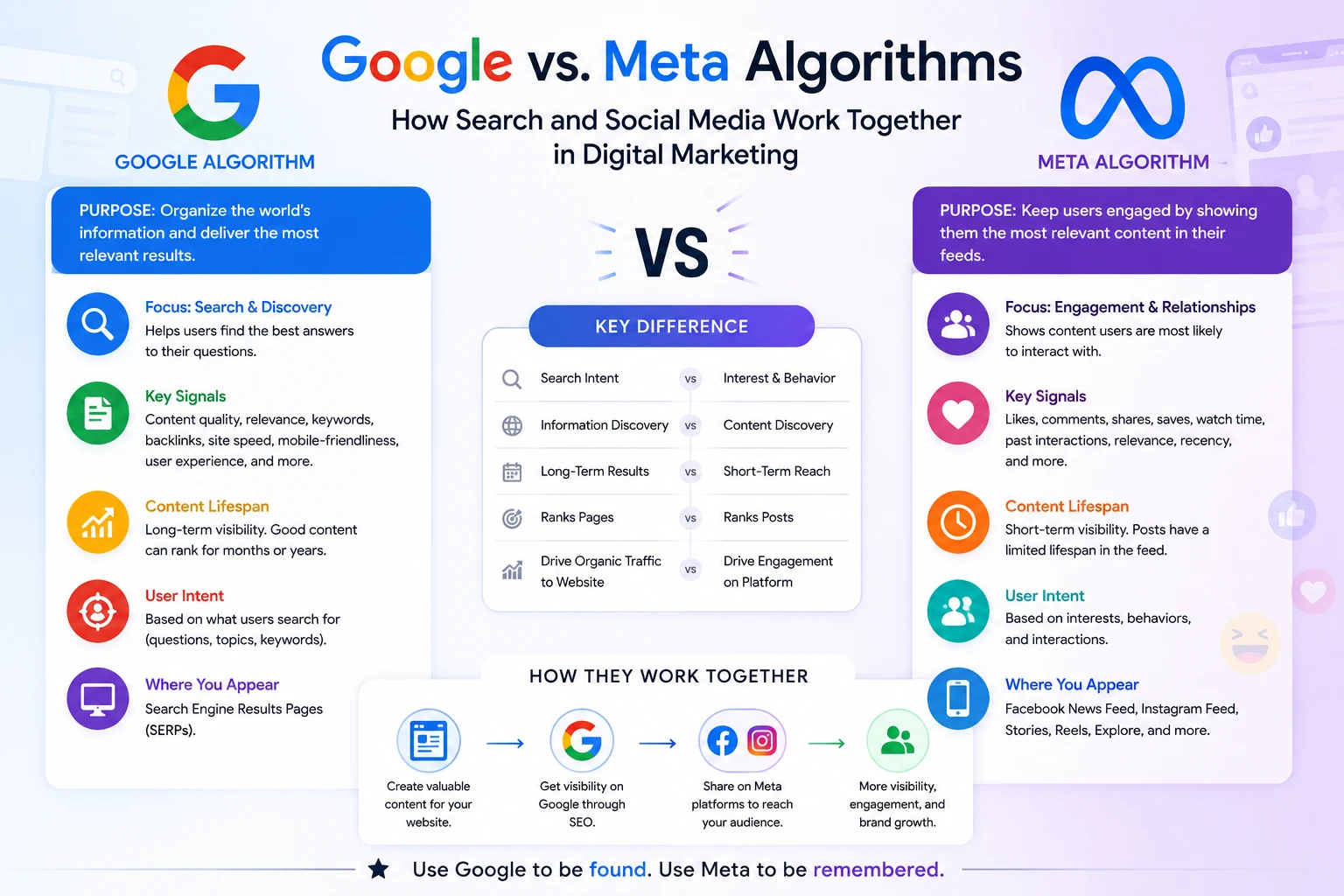
Google’s algorithm is a sophisticated system that ranks web pages based on relevance, quality, and user experience. When someone searches for a topic, Google analyzes billions of pages and displays the results that best match the user’s search intent.
Google considers several ranking factors, including:
- High-quality and helpful content
- Search intent
- Keyword relevance
- Mobile-friendliness
- Website speed
- Backlinks from trusted websites
- Secure browsing (HTTPS)
- Overall user experience
The goal of Google’s algorithm is to provide users with accurate, reliable, and useful information as quickly as possible. This is why websites that focus on quality content and a positive user experience are more likely to achieve better search rankings.
What Is Meta’s Algorithm?
Unlike Google, Meta’s algorithms don’t rank websites—they rank content on platforms such as Facebook and Instagram. Their primary objective is to keep users engaged by showing posts they are most likely to interact with.
Meta’s algorithm evaluates signals such as:
- Likes, comments, and shares
- Watch time on videos
- Previous interactions with a creator or brand
- Relevance to the user’s interests
- Content freshness
- Saves and profile visits
Instead of answering a search query, Meta aims to deliver a personalized social media experience. As a result, engaging and authentic content generally performs better than overly promotional posts.
Google vs. Meta: What’s the Difference?
Although both algorithms analyze user behavior, they have different goals.
Google focuses on helping users find information through search results. Success on Google depends on creating valuable, optimized content that satisfies search intent and provides long-term value.
Meta focuses on helping users discover content as they scroll through social media. Success on Meta depends on encouraging engagement, building relationships with your audience, and creating content that captures attention quickly.
In simple terms:
- Google answers questions.
- Meta encourages conversations.
Understanding this difference helps marketers create content that matches each platform’s purpose.
How Google and Meta Work Together
Rather than competing, Google and Meta can complement each other as part of a digital marketing strategy.
For example, imagine you publish a blog about SEO on your website. By optimizing it for Google, your article can attract organic traffic from search results over time. You can then share the same blog on Facebook or Instagram to introduce it to your followers and encourage them to visit your website.
Similarly, a social media post can increase brand awareness, while your website provides more detailed information that helps convert visitors into customers or subscribers.
Using both platforms together allows businesses to combine the long-term benefits of SEO with the immediate reach of social media marketing.
Best Practices for Digital Marketers
To get the best results from both Google and Meta, focus on creating content that provides value to your audience.
Some effective practices include:
- Write helpful, original, and informative content.
- Optimize your website for SEO using relevant keywords and clear headings.
- Publish engaging images, videos, and captions on social media.
- Encourage meaningful interactions instead of chasing vanity metrics.
- Maintain a consistent posting schedule.
- Monitor performance using analytics tools and refine your strategy based on real data.
By understanding the strengths of each platform, marketers can build a balanced strategy that reaches audiences at different stages of their journey.
Final Thoughts
Google and Meta algorithms may work differently, but they share a common objective: delivering the most relevant content to users.
Google helps people discover information through search, while Meta helps people discover content through social interactions. A successful digital marketing strategy doesn’t rely on one platform alone—it combines the strengths of both.
For digital marketers, learning how these algorithms function is more than just understanding technology. It’s about creating valuable content, improving user experiences, and building meaningful connections with your audience. By focusing on quality, relevance, and authenticity, you can improve your visibility across both search engines and social media platforms while building a stronger online presence.