


Imagine searching for “best coffee shops near me” on Google. Within seconds, thousands of websites compete for your attention, yet Google manages to display the most relevant results at the top. This isn’t random—it’s the work of Google’s algorithms.
For anyone learning digital marketing, understanding Google algorithms is essential. They influence how websites appear in search results and ultimately determine how easily users can discover your content. Whether you’re managing a business website, writing blog posts, or building a personal portfolio, knowing how these algorithms work can help you create content that reaches the right audience.
What Are Google Algorithms?
Google algorithms are a collection of systems and ranking signals that evaluate billions of web pages to determine which ones deserve to appear in search results. Their primary goal is simple: to provide users with the most relevant, trustworthy, and helpful information for every search query.
Rather than focusing on a single factor, Google evaluates hundreds of signals before deciding how pages should rank. These include content quality, page speed, mobile usability, backlinks, website security, and overall user experience.
Google also updates its algorithms regularly to improve search quality and reduce spam. This means SEO is not about finding shortcuts—it’s about adapting to Google’s goal of delivering the best possible user experience.
Why Google Algorithms Matter for SEO
Search Engine Optimization (SEO) is the process of improving a website so it can rank higher in organic search results. Google algorithms are at the center of this process because they decide which pages deserve visibility.
When your website aligns with Google’s quality standards, it becomes more likely to:
- Rank higher for relevant keywords.
- Attract consistent organic traffic.
- Build trust with visitors.
- Increase engagement and conversions.
- Stay competitive in search results.
Understanding Google’s algorithms allows marketers to focus on long-term growth instead of chasing temporary ranking tricks.
How Google Decides Which Pages Rank
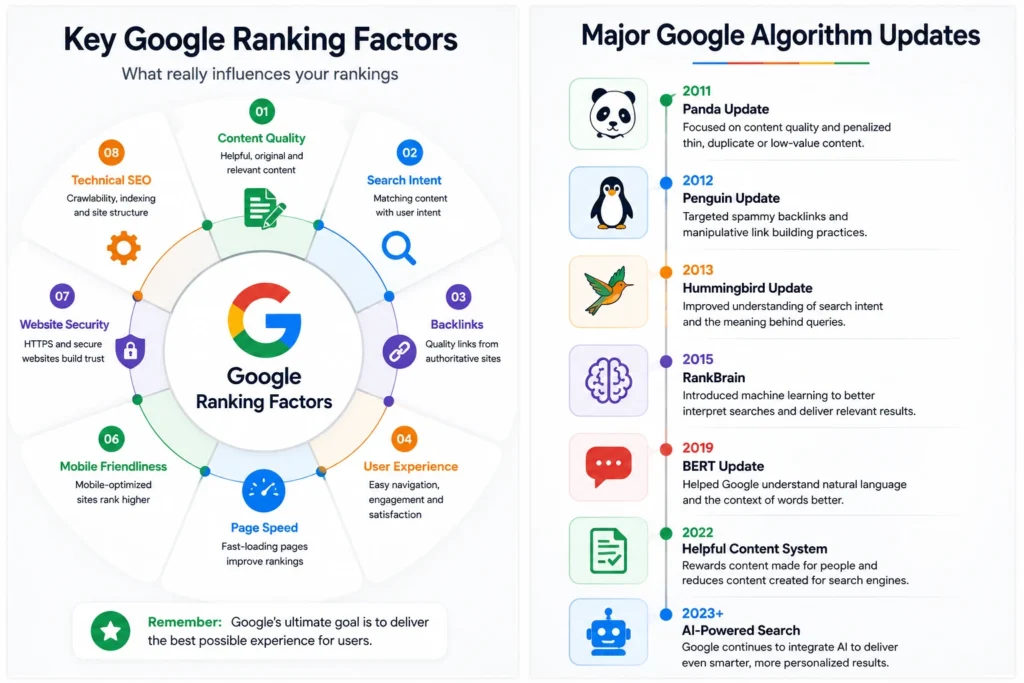
Although Google doesn’t reveal every ranking factor, several key elements consistently influence search performance.
1. Helpful and Original Content
Google rewards content that genuinely answers users’ questions. Original insights, practical examples, and well-structured information are more valuable than content created solely to rank for keywords.
2. Search Intent
Every search has an intention behind it. Someone searching for “how to start a blog” expects a step-by-step guide, while someone searching for “best blogging platforms” wants comparisons. Matching the user’s intent is one of the most important aspects of SEO.
3. Keyword Optimization
Keywords help Google understand what your content is about. However, modern SEO is about using keywords naturally rather than repeating them excessively. Well-written content that flows naturally performs better than content overloaded with keywords.
4. User Experience
Google values websites that are easy to navigate, mobile-friendly, and fast to load. A positive browsing experience encourages users to stay longer, which often signals that the content is useful.
5. Backlinks
Backlinks are links from other websites pointing to your content. High-quality backlinks from reputable websites can improve your site’s credibility and authority in Google’s eyes.
Major Google Algorithm Updates
Google has introduced several major algorithm updates that have changed SEO over the years.
Panda focused on reducing low-quality and duplicate content.
Penguin targeted websites using spammy or manipulative backlink strategies.
Hummingbird improved Google’s ability to understand the meaning behind search queries rather than matching exact keywords.
RankBrain introduced machine learning to interpret unfamiliar searches better and improve search results.
BERT enhanced Google’s understanding of natural language, making it easier to interpret conversational and complex queries.
More recently, Google’s Helpful Content System emphasizes content created for people rather than search engines, encouraging websites to prioritize value over ranking tricks.
Common SEO Mistakes to Avoid
Many beginners believe SEO is about manipulating Google’s algorithm. In reality, these outdated practices often do more harm than good.
Some common mistakes include:
- Keyword stuffing.
- Publishing duplicate or AI-generated content without adding original value.
- Ignoring mobile optimization.
- Having slow-loading web pages.
- Using misleading titles or clickbait.
- Buying low-quality backlinks.
Instead of looking for shortcuts, focus on creating a website that genuinely helps users.
Best SEO Practices for Today
SEO continues to evolve, but some principles remain timeless.
Start by writing content for people first, not search engines. Use clear headings, organize your content logically, and answer readers’ questions straightforwardly.
Keep your website fast and mobile-friendly, as many users browse primarily on smartphones. Update older content regularly to keep it relevant and accurate. Finally, monitor your website’s performance using tools like Google Search Console and Google Analytics to understand what works and where improvements are needed.
The most successful websites are those that consistently publish valuable content while maintaining a positive user experience.
Final Thoughts
Google algorithms are constantly evolving, but their mission remains the same: connecting users with the most helpful information available.
For digital marketers, this means SEO is no longer about gaming the system. It’s about understanding your audience, creating high-quality content, and building websites that people genuinely enjoy using.
As search technology continues to advance with artificial intelligence and smarter ranking systems, marketers who focus on authenticity, user experience, and valuable content will always have an advantage. Instead of chasing every algorithm update, focus on helping your audience, and Google’s algorithms are more likely to reward your efforts.